Compressed air powers production equipment in almost every manufacturing facility. From assembly lines and CNC machines to packaging systems and robotic automation, a reliable air supply helps factories maintain productivity and product quality.
However, not every rotary screw air compressor is suitable for every factory. The right compressor depends on production requirements, air demand, operating hours, energy consumption, and air quality.
This guide explains how to choose the right screw air compressor for manufacturing, what specifications to consider, and how different system components work together to improve performance and reduce operating costs.
To choose a screw air compressor for manufacturing, determine your required airflow (cubic feet per minute), operating pressure (pounds per square inch), daily operating hours, air quality requirements, and future production plans. Factories with changing air demand often benefit from compressors with variable speed drives, while facilities with stable production may choose fixed speed models.
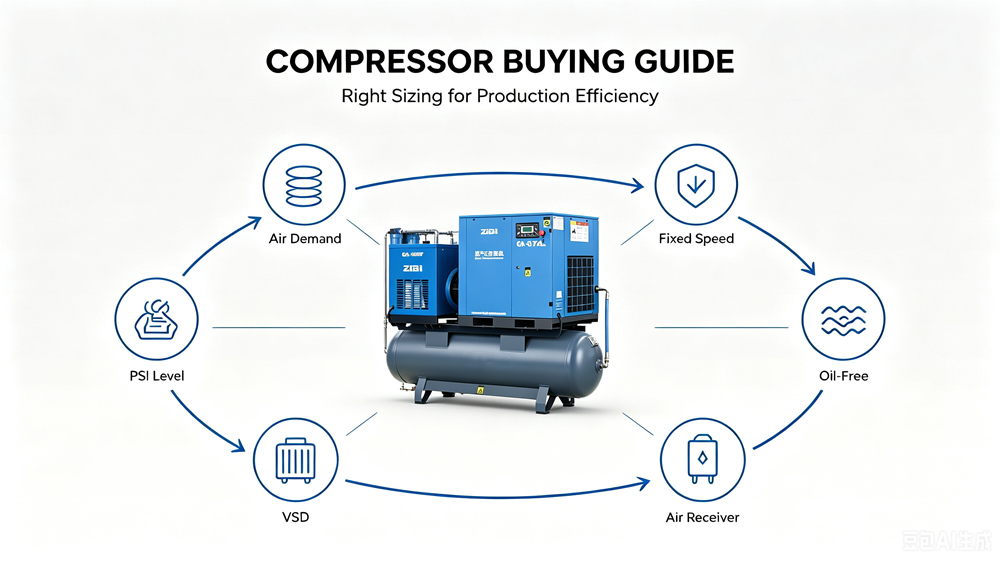
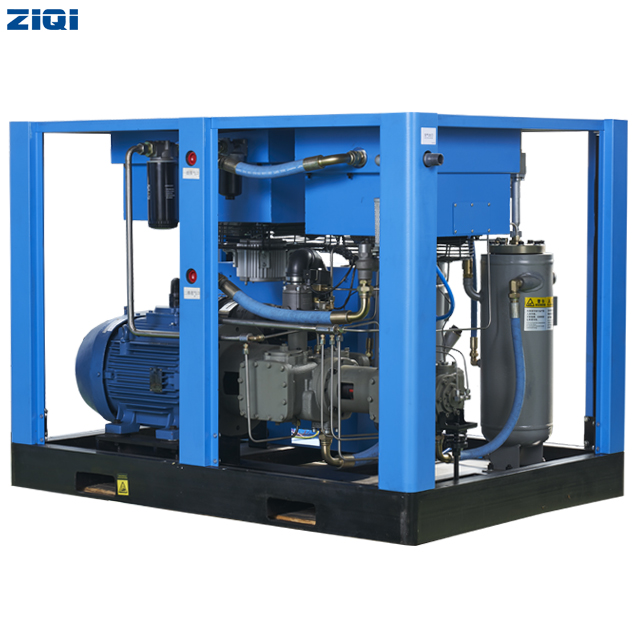
A rotary screw air compressor produces compressed air by using two interlocking rotors that continuously compress incoming air.
Unlike piston compressors, rotary screw compressors are designed for continuous operation, making them well suited for manufacturing environments where equipment runs throughout the day.
Their advantages include:
The first step is determining your factory's air demand.
Every pneumatic machine requires a certain amount of airflow, usually measured in cubic feet per minute (CFM).
To estimate total airflow:
Selecting a compressor that is too small may reduce productivity, while an oversized unit can increase energy consumption.
Air pressure is typically measured in pounds per square inch (PSI).
Different manufacturing processes require different pressure levels.
For example:
| Application | Typical Pressure |
|---|---|
| General assembly | 90–100 PSI |
| CNC machining | 90–125 PSI |
| Packaging equipment | 80–100 PSI |
| Laser cutting support | 100–145 PSI |
| PET bottle blowing | Much higher pressure using dedicated systems |
Always select a compressor based on the highest pressure required by your production equipment rather than increasing pressure unnecessarily.
One of the most important decisions is selecting between fixed speed compressors and compressors with variable speed drives.
A fixed-speed compressor operates at one motor speed whenever it is running.
Advantages include:
Compressors equipped with variable speed drives automatically adjust motor speed according to real time air demand.
Benefits include:
For factories where production changes throughout the day, variable-speed technology is often the more economical option.
Not every manufacturing process requires the same air quality.
Some industries need standard compressed air, while others require extremely clean air.
Typical examples include:
An oil free compressor is recommended whenever compressed air comes into contact with products or sensitive equipment.
For general industrial production, oil lubricated compressors remain a popular choice because they offer reliable performance and lower purchase costs.
Producing compressed air is only one part of the system.
A complete compressed air installation should also include air treatment equipment.
Typical components include:
Proper air treatment removes moisture, dust, and oil particles before compressed air reaches production equipment.
This helps protect machinery and improve product consistency.
An air receiver stores compressed air after it leaves the compressor.
Its functions include:
Correctly sizing the receiver tank helps maintain a more stable air supply throughout the factory.
Electricity is one of the largest operating costs of any compressed air system.
Choosing an energy efficient compressor can significantly reduce long-term operating expenses.
Features that improve efficiency include:
Regular maintenance also contributes to better energy saving performance over the life of the equipment.
Different industrial applications have different compressed air requirements.
Examples include:
Continuous airflow for assembly tools, welding equipment, and robotic systems.
Clean compressed air with minimal moisture and oil contamination.
An oil free compressor is often preferred to meet hygiene requirements.
Reliable airflow for spinning, weaving, and automation equipment.
Stable compressed air for CNC machines, cutting equipment, and pneumatic tools.
Selecting equipment based on actual production needs results in better overall performance.
When comparing compressors, manufacturers often specify Free Air Delivery (FAD).
Free air refers to the volume of atmospheric air delivered by the compressor under specified conditions.
Unlike theoretical displacement, FAD represents the actual airflow available for production equipment.
Comparing compressors using Free Air Delivery provides a more accurate picture of real performance.
Modern factories rarely install only one compressor.
Most facilities build complete air systems that include:
A complete system provides more stable airflow, better air quality, and easier maintenance.
Many buyers make avoidable mistakes, such as:
Planning the entire compressed air system often produces better long-term results.
The best compressor depends on airflow, pressure requirements, operating hours, air quality, and future production needs. Rotary screw compressors are commonly selected because they provide reliable continuous operation.
A fixed speed compressor works well when air demand remains stable. Compressors with variable speed drives are better for factories where air consumption changes throughout the day because they automatically adjust output in real time.
Free Air Delivery (FAD) measures the actual volume of free air delivered by a compressor under specified conditions. It is one of the most useful specifications when comparing compressor performance.
An oil free compressor is recommended for industries requiring clean compressed air, including food processing, pharmaceuticals, electronics, and medical manufacturing.
Air dryers remove moisture from compressed air. Dry air helps prevent corrosion, protects equipment, and improves production consistency.
Choosing an energy efficient compressor, installing variable speed drives, repairing air leaks, maintaining proper pressure, and servicing air treatment equipment all contribute to better energy saving performance.
Choosing the right rotary screw air compressor involves much more than selecting a machine with enough power. Airflow, pressure, operating hours, air quality, and future expansion all influence system performance.
By understanding your air demand, selecting the correct air receiver, using appropriate air treatment equipment such as air dryers, and considering variable speed drives for changing production conditions, manufacturers can build reliable and energy efficient compressed air systems that support a wide range of industrial applications for years to come.