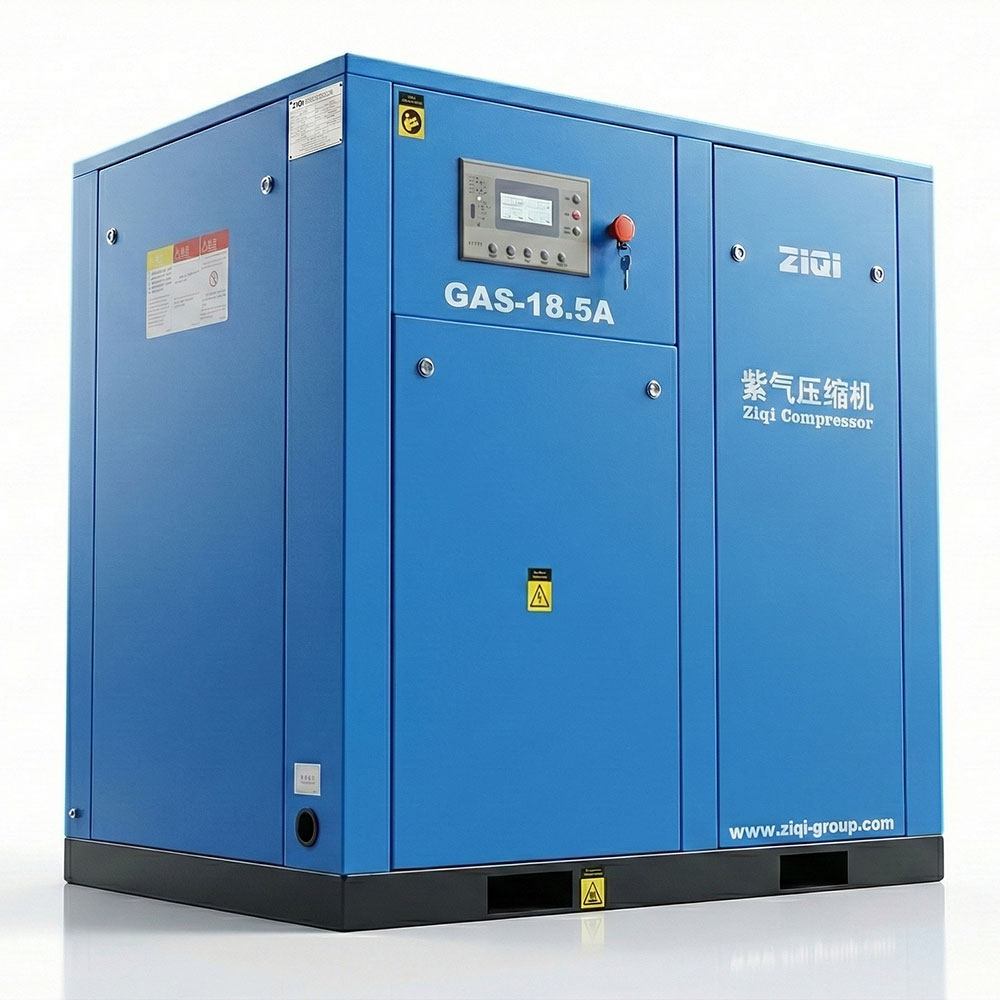
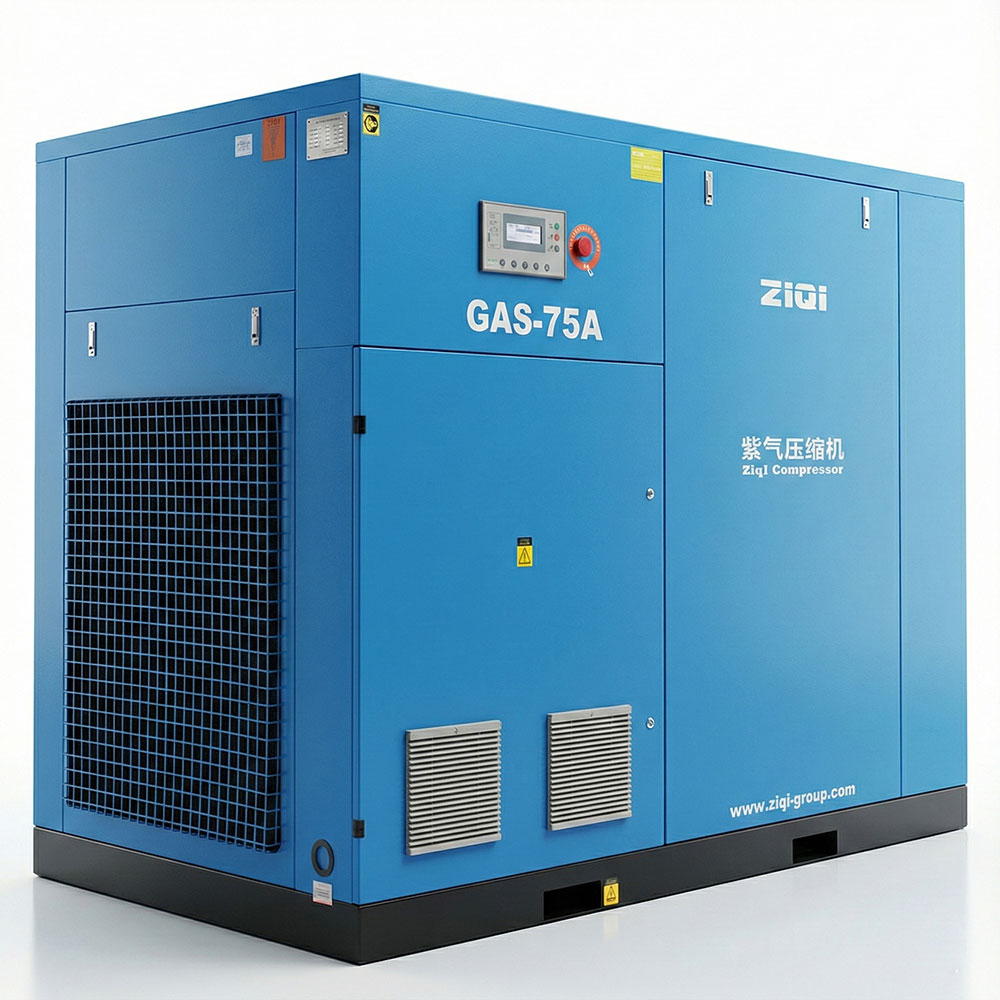
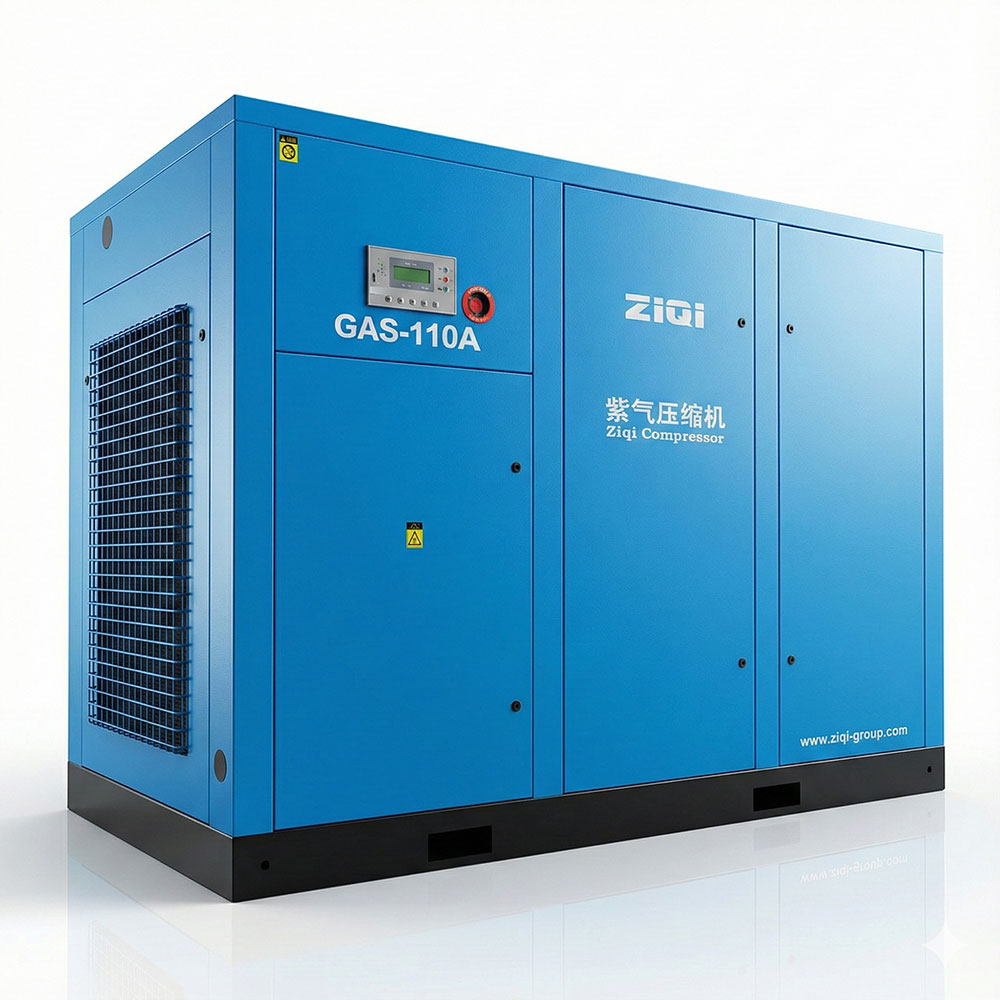
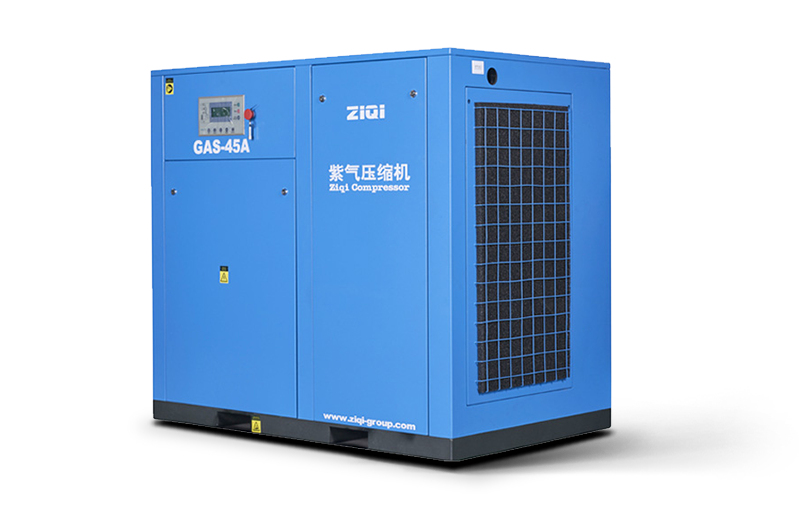
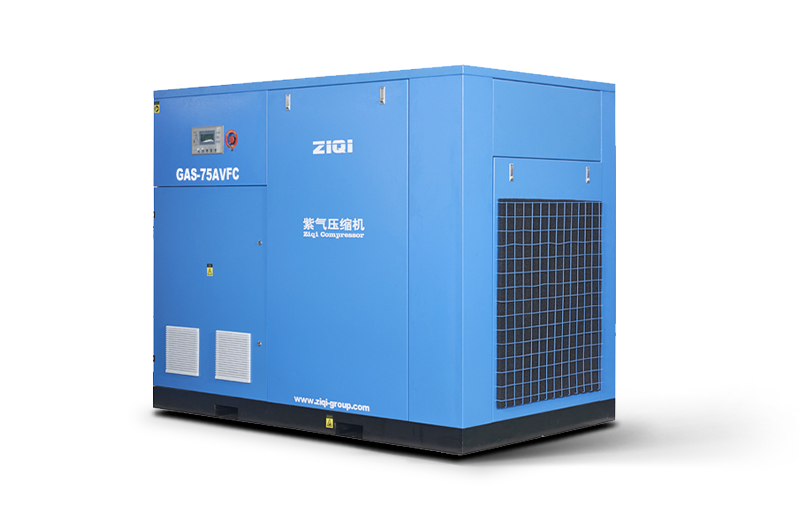
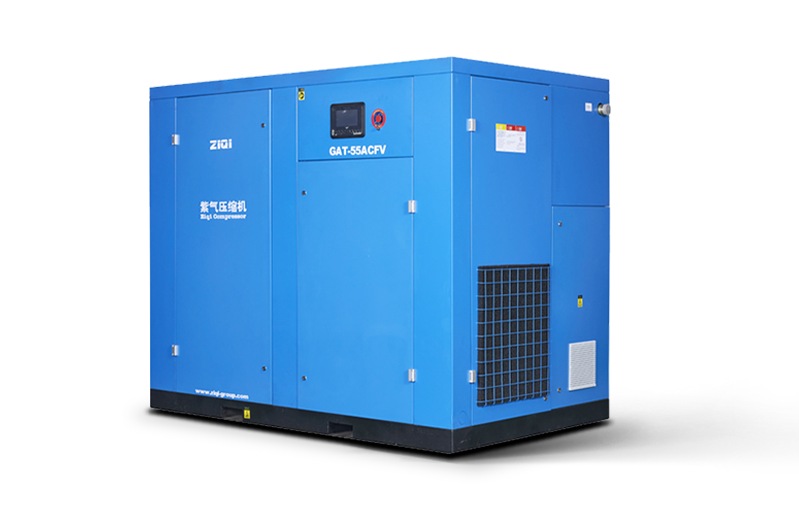
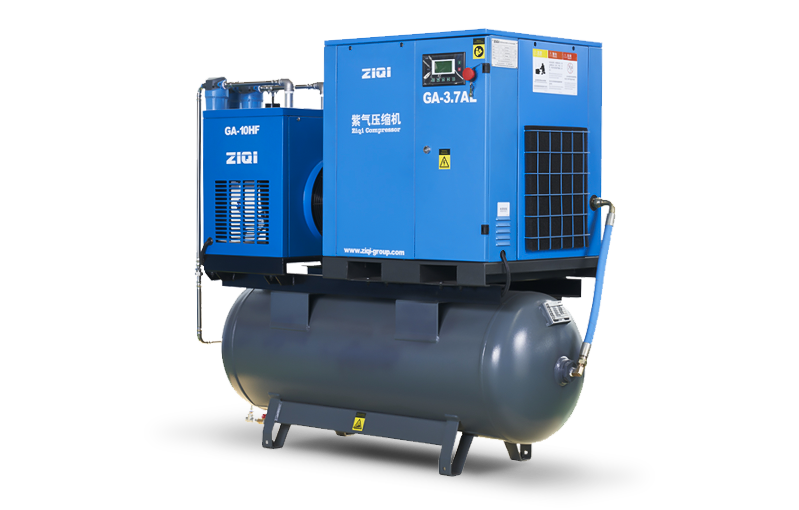
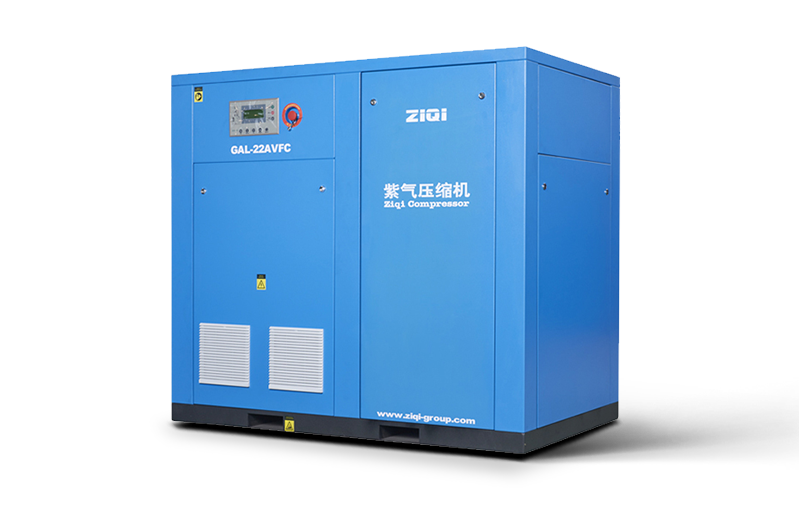
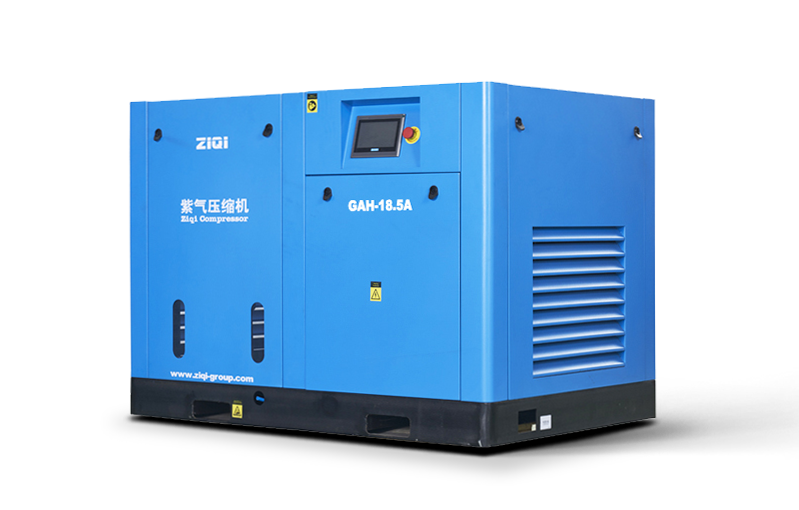
What Makes the GAS Series Different?
Most "screw compressors" on the market look similar from the outside. The
difference is inside. Standard machines use domestic airend copies
(30,000–50,000h life) and IE2/IE3 motors. The ZIQI GAS uses an
original German GHH RAND airend (100,000+h design life) and
a WEG IE4 Super Premium motor — the highest commercially
available efficiency class.
For a factory running compressors 6,000+ hours per year, electricity is
75–80% of total ownership cost. The IE4 upgrade alone saves $1,200–$3,600
annually depending on motor size. If your demand fluctuates significantly,
consider our VSD
variable speed models for even greater savings. For high-demand
lines needing 15%+ more air per kW, see our two-stage
GAT series.
⚙️
Star-Delta Soft Start
Simplified electrical system with fewer electronic components than VFD.
Higher reliability in harsh industrial environments with voltage
fluctuations. Uses Schneider/Siemens contactors — globally serviceable.
🛠️
Service-Friendly Layout
Wide-access panel design provides direct reach to air filter, oil filter,
separator, and oil cooler. Reduces scheduled maintenance time. No
special tools required for routine service.
🌡️
45°C Ambient Rating
Oversized aluminum after-cooler and oil cooler rated for 45°C continuous
operation. For hotter environments, models 55 kW+ offer water-cooled
variants (GAS-xxA/W suffix).
🏭
24/7 Manufacturing Baseload
Automotive, steel, textile, and plastic injection plants running 3 shifts
with constant air demand. Fixed-speed simplicity means fewer electronics
to fail in dusty, hot factory environments. The GHH airend runs 100,000+
hours before overhaul.
🔧
Workshop & Small Factory
Machine shops, body repair, woodworking, and general workshops.
Belt-drive models (7.5–45 kW) offer the lowest upfront cost with proven
reliability. Easy maintenance — belt change takes under 30 minutes.
🧱
Building Materials & Cement
High-dust, high-temperature environments where electronic VFD drives are
at risk. The GAS fixed-speed with star-delta start and oversized coolers
(45°C rated) thrives where sensitive electronics struggle.
🚢
Export & Remote Sites
Shipyards, mining sites, and developing regions where power quality is
inconsistent and VFD-qualified technicians are scarce. Fixed-speed with
Schneider/Siemens contactors is globally serviceable — no proprietary
VFD boards to source.
Why Motor Efficiency Matters
Electricity = 78% of Your Compressor's Lifetime
Cost
For a 75 kW compressor running 6,000h/year at
$0.10/kWh, electricity costs $45,000 per year. The machine itself costs
$8,000–$15,000. An IE4 motor saves 3–5% — that's $1,350–$2,250 annually,
paying back the premium in months.
Direct Drive Models — 55 to 180 kW
Direct Drive ·
Air/Water-Cooled
* "A" = Air-Cooled, "A/W" = Air or Water-Cooled option
available (55 kW+). All data verified against master spec sheet. Air
delivery measured in FAD at stated pressure. Specifications subject to
change. Contact us for exact
configuration and pricing.
When should I choose a fixed speed compressor over a
VSD?
Choose fixed speed when your air demand is constant
and stable — running near 100% load for most operating hours. Fixed
speed costs 15–25% less upfront and has fewer electronic components to
fail. If demand fluctuates more than 30%, a
VSD compressor
saves more energy. Many factories use a fixed-speed GAS as baseload + a
VSD for variable trim.
What is a GHH RAND airend and why does it matter?
GHH RAND is a German manufacturer that pioneered the
asymmetric screw rotor profile. Their airends deliver higher volumetric
efficiency, lower vibration, and dramatically longer life than domestic
copies. The GHH airend in ZIQI GAS compressors has a design life of
100,000+ hours — roughly 2–3× longer than generic airends that need
rebuilding at 30,000–50,000 hours. Each avoided rebuild saves
$3,000–$6,000.
How much electricity does a screw compressor use per
year?
A 22 kW compressor running 6,000 hours/year at
$0.10/kWh costs approximately $13,200 in electricity. A 75 kW unit costs
about $45,000/year. Electricity is 75–80% of total lifetime cost —
making motor efficiency the single most important factor in long-term
ROI. The IE4 upgrade saves 3–5%, which adds up to $15,000–$35,000 over
10 years on larger models.
What is the difference between belt drive and direct
drive?
Belt drive uses V-belts — simpler, cheaper, adequate
for 7.5–45 kW. Belts need replacement every 3,000–5,000 hours and lose
3–5% energy in transmission. Direct drive uses a 1:1 coupling — zero
belt loss, zero belt replacement, lower vibration. ZIQI uses direct
drive on all models 55 kW and above where the energy savings justify the
cost.
What size screw compressor do I need?
Add up the air consumption of all pneumatic tools and
equipment, then add 20–30% buffer. Match to the spec table at your
required pressure. Example: if you need 5 m³/min at 8 bar, the GAS-30A
delivers 5.5 m³/min. Not sure?
Send us your
equipment list and we'll calculate the optimal model for free.
Can this compressor work in tropical climates above
40°C?
Yes. All GAS models feature oversized aluminum
coolers rated for continuous operation at 45°C ambient. For environments
exceeding 45°C, models 55 kW and above offer water-cooled variants
(GAS-xxA/W) that use a facility water circuit. We have extensive
deployments across Southeast Asia, Middle East, and Africa.
How much can I save by upgrading from IE2 to IE4
motor?
At full load, IE4 is 3–5% more efficient than IE2.
For a 75 kW unit running 6,000h/year at $0.10/kWh, that saves
$1,350–$2,250 annually. Over 10 years: $13,500–$22,500 cumulative
savings vs. a $500–$1,000 motor cost premium. The payback period is
typically 3–6 months.
What is the maintenance schedule for the GAS series?
Oil and oil filter: every 3,000–4,000 hours. Air
filter: every 2,000–3,000 hours. Separator element: every 4,000–6,000
hours. Belts (belt-drive models): every 3,000–5,000 hours. Bearing
inspection: at 30,000 hours. The GHH airend itself is designed for
100,000+ hours before major overhaul — roughly 12–16 years at typical
operating hours.
What is the noise level of a screw air compressor?
62±2 dB(A) for the 7.5 kW model up to 77±2 dB(A) for
the 180 kW model. For reference, 65 dB is normal conversation volume.
All models include sound-dampened enclosures. For noise-sensitive
environments, consider installing in a separate compressor room with
acoustic treatment, or pair with our
aluminum piping
system to keep the compressor further from work areas.