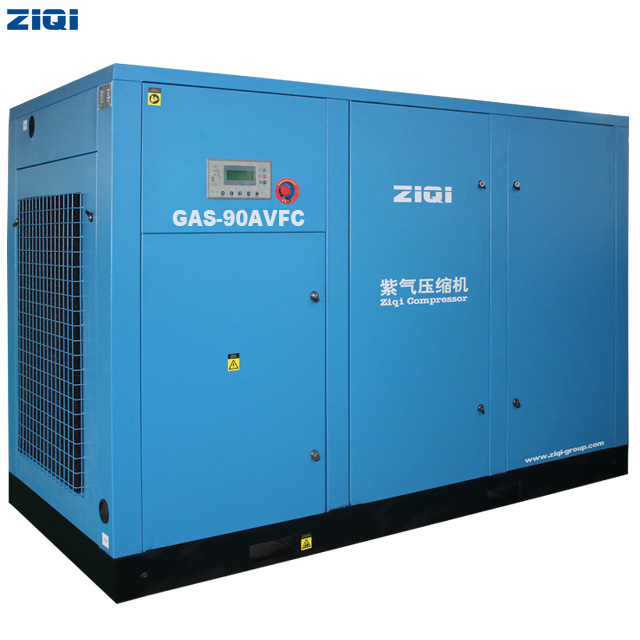
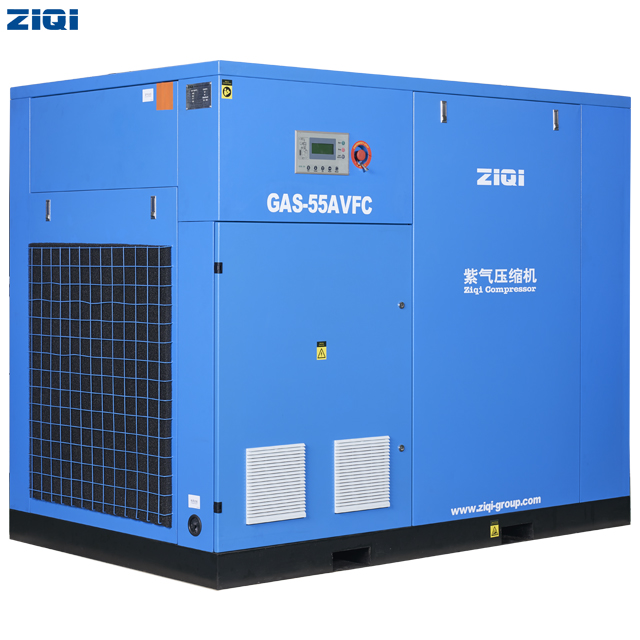
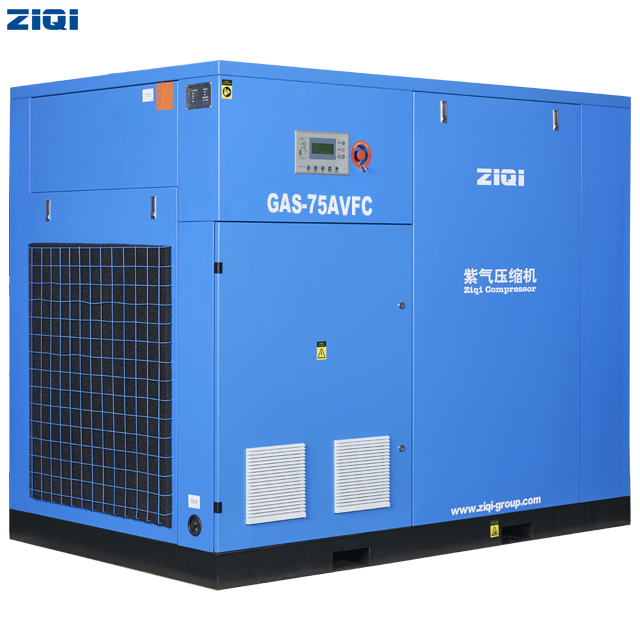
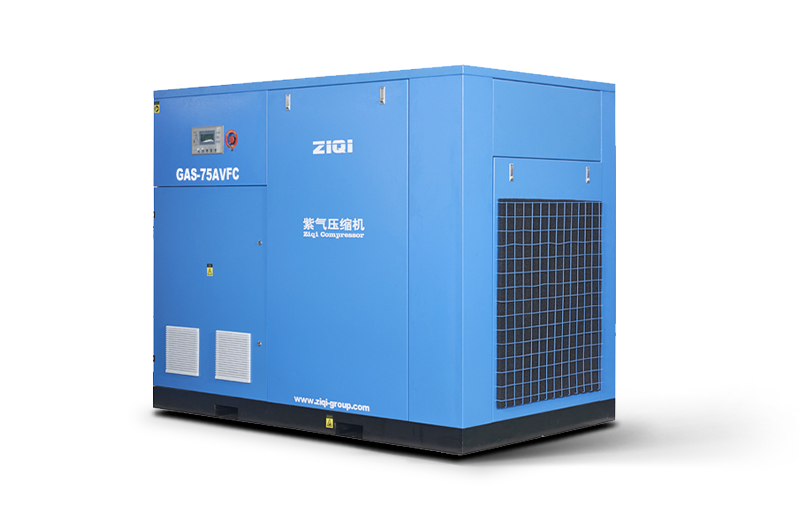
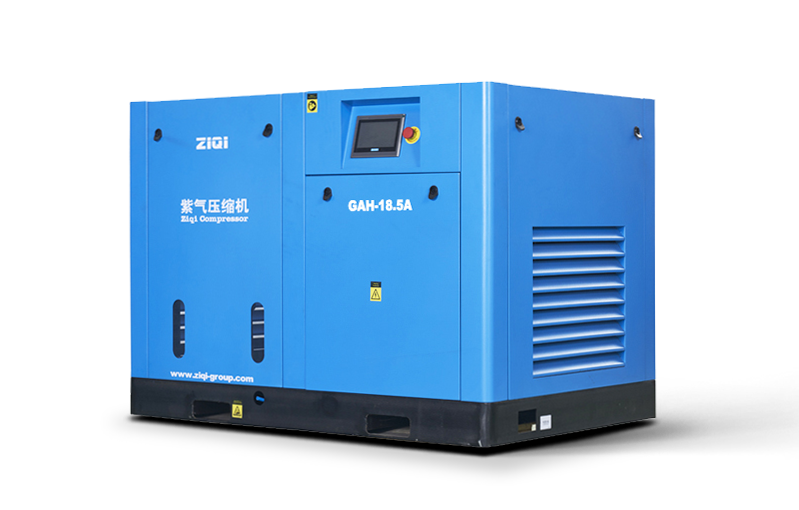
Why Choose GAS VFC Over Standard VSD Compressors?
Most VSD compressors on the market pair a generic airend with a basic V/F
inverter. The ZIQI GAS VFC combines three premium
components: an original German GHH RAND airend (100,000+h
design life), a WEG IE4 Super Premium motor, and a
vector-control VFD that responds in milliseconds —
delivering 25–35% energy savings with superior speed accuracy.
For constant-demand baseload applications, see our GAS fixed
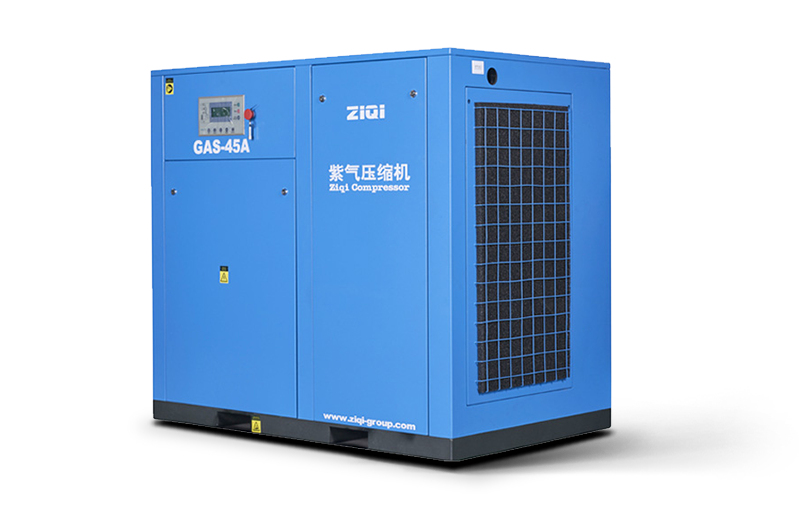
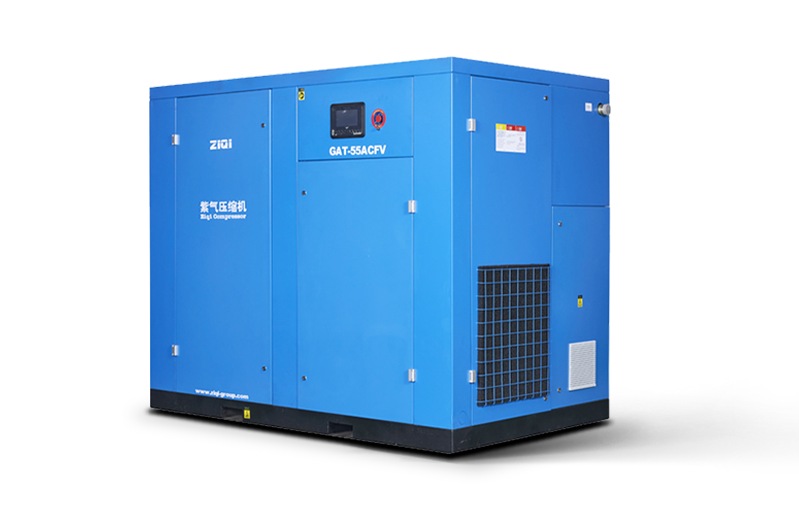
speed series. For 15% more air per kW at high pressure, see our GAT
two-stage series. Many large factories pair a fixed-speed GAS for
baseload with a VFC for variable trim — maximizing savings across the entire
demand range.
📉
25–35% Energy Saving
VFD eliminates load/unload cycling and blow-off waste. A 75 kW VFC
running 6,000h/year saves $11,000–$16,000 annually vs fixed speed at
typical variable demand profiles.
🔇
Lower Noise at Part Load
When demand drops, the VFD slows the motor — reducing noise by 5–8 dB at
50% load. Full-speed noise ranges from 62 dB (7.5 kW) to 77 dB (180 kW).
🧠
Intelligent Control
LCD touchscreen monitors pressure, temperature, and maintenance schedule
in real-time. PID control maintains stable system pressure within ±0.01
MPa — eliminating pressure fluctuation.
🏭
Multi-Shift Manufacturing
Factories running 2–3 shifts with varying production loads. Day shift at
100%, night shift at 40%. VSD matches output to each shift's demand
instead of running full-speed and venting excess air.
🔧
Batch Processing
Food, beverage, and pharmaceutical plants with batch production cycles.
Air demand surges during filling/packaging then drops during changeover.
VSD handles both smoothly without pressure spikes.
🖨️
Printing & Packaging
Printing presses and packaging lines with intermittent pneumatic demand.
Precise pressure control (±0.01 MPa) prevents print quality issues
caused by pressure fluctuation.
⚡
Base + Trim Configuration
Large factories pairing a fixed-speed GAS for constant baseload with a
GAS VFC for variable trim. This strategy maximizes savings across the
entire demand curve — 15–25% better than VSD-only.
VSD Payback Calculator
75 kW VFC Saves $11,000–$16,000/Year vs Fixed Speed
At 6,000h/year, $0.10/kWh, with 40–80% average load.
The VSD premium pays back in 12–18 months. Over 10 years, cumulative
savings exceed $110,000–$160,000.
Direct Drive VFC — 55 to 180 kW
Direct Drive · VFD ·
Air/Water-Cooled
* Min–max flow range = VSD variable output. "A/W" =
Air or Water-Cooled (55 kW+). GAS-185A/W: 180 kW motor. All data verified
against master spec sheet. Contact us for exact
configuration and pricing.
When should I choose VSD over fixed speed?
Choose VSD when air demand fluctuates more than
30% during operating hours. Typical savings are 25–35% on electricity.
VSD also provides soft-start capability, eliminating high inrush
currents and reducing mechanical stress. If demand is constant and
stable (near 100% load most of the time), a
fixed-speed
GAS is more cost-effective.
What is vector control VFD?
Vector control is an advanced motor drive
technology that adjusts both voltage and frequency simultaneously for
precise speed control. Unlike basic V/F control, vector control responds
in milliseconds, maintains full torque at low speeds, and achieves 3–5%
higher efficiency. This means smoother operation, more accurate pressure
control, and better energy savings at part load.
How much energy does a VSD compressor save?
Typically 25–35% compared to a fixed-speed
compressor running load/unload cycles. A 75 kW VFC running 6,000
hours/year at $0.10/kWh saves approximately $11,000–$16,000 annually vs
fixed speed. The VSD premium typically pays back in 12–18 months. Over
10 years, cumulative savings exceed $110,000.
What is the difference between GAS fixed speed and
GAS VFC?
Same German GHH airend and WEG IE4 motor. The VFC
adds a variable frequency drive that adjusts motor speed from 25% to
100% based on real-time air demand. Fixed speed is better for constant
baseload. VFC is better for fluctuating demand. Many factories use one
fixed-speed as baseload plus one VFC for variable trim — this maximizes
savings across the entire demand range.
Can VSD compressors run at very low loads?
Yes. The GAS VFC can modulate down to
approximately 25% of rated capacity. Below that, it enters standby mode
and restarts when pressure drops. This wide turndown ratio is a key
advantage — fixed speed can only run at 100% or 0% (idle).
What is the flow range shown in the specification
table?
The min–max range represents variable speed
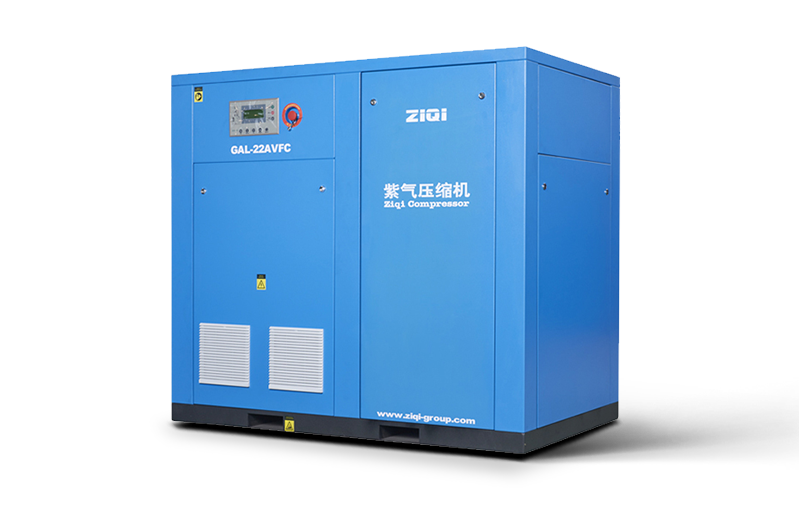
output. For example, GAS-22AVFC at 0.7 MPa shows 0.36–3.6 m³/min. This
means the compressor can deliver anywhere from 0.36 m³/min at minimum
speed to 3.6 m³/min at full speed — continuously adjusting to match your
actual air demand.
Does VSD reduce compressor noise?
Yes. When air demand is low, the VFD reduces motor
speed, which significantly lowers noise. At 50% load a VSD compressor is
typically 5–8 dB quieter than a fixed speed unit running load/unload.
This is especially noticeable in smaller workshop environments where the
compressor is near the work area.
What size VSD compressor do I need?
Size the VSD so that your average demand falls at
60–80% of rated capacity. This gives room to handle peaks without
oversizing. For example, if average demand is 5 m³/min at 0.8 MPa with
peaks to 7 m³/min, the GAS-45AVFC (max 7.4 m³/min at 0.8 MPa) is ideal.
Send
us your demand data for a free sizing recommendation.